UK CBAM: New emissions values and indicative rates give importers first insight into 2027 costs
23 October 2026
UK importers now have a clearer indication of the potential costs they could face under the Carbon Border Adjustment Mechanism (CBAM), following the publication of new Government guidance ahead of its introduction on 1 January 2027.
On 16 October 2026, HM Treasury and HM Revenue & Customs published illustrative CBAM rates and official default emissions values, providing businesses with important information to help them prepare for the new carbon pricing requirements.
The announcement represents a significant development for importers of carbon-intensive goods, particularly those sourcing products from overseas manufacturers where detailed emissions information may not be readily available.
First indicative CBAM rates published
The UK CBAM will apply a carbon price to imports of certain goods in five sectors: aluminium, cement, fertilisers, hydrogen, and iron and steel.
For the first time, the Government has published illustrative rates showing how the charges could vary between these sectors.
The indicative rates are:
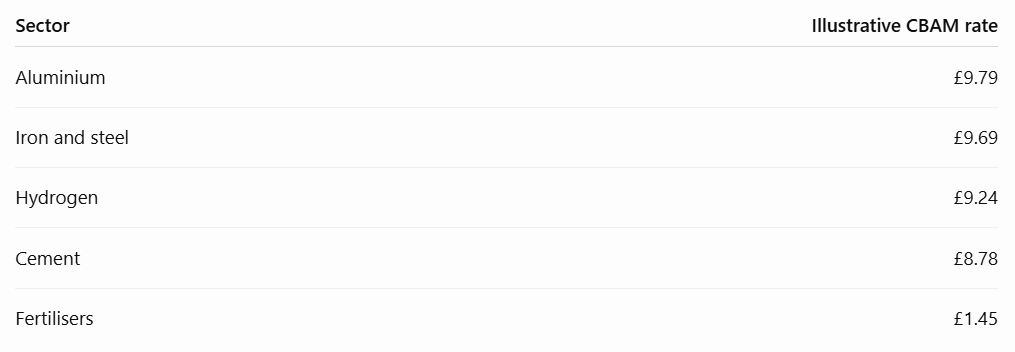
These figures are based on preliminary emissions data and recent UK Emissions Trading Scheme (UK ETS) carbon prices.
Importantly, these are illustrative rates, not the final charges that will apply in 2027. The Government has confirmed that the first official rates will be published before the end of December 2026, with subsequent rates updated quarterly.
The actual CBAM liability will depend on the emissions associated with the imported goods, the applicable sector rate and any eligible carbon price relief.
The Government has published a worked example explaining how CBAM rates are calculated.
New default emissions values confirmed
Alongside the illustrative rates, the Government has published default emissions values that importers can use when verified emissions data from overseas suppliers is unavailable.
These values provide a standard measure of the emissions associated with specific products, expressed in tonnes of carbon dioxide equivalent per tonne of goods.
The Government has confirmed that:
-
Default values will apply during 2027 and 2028
-
A 10% uplift has been applied to default emissions values in most sectors
-
Fertilisers are excluded from the 10% uplift
-
Country-specific default emissions values are planned from 2029
The uplift is intended to encourage businesses to obtain verified emissions information rather than rely on standard default figures.
For importers, this creates an important commercial consideration. Where actual verified emissions are lower than the published default values, obtaining reliable supplier data could help reduce potential CBAM costs.
However, businesses using default values in a submitted CBAM return will not be able to amend that return later to substitute actual emissions data.
The Government has published default emissions values for all five sectors, allowing importers to identify the figures relevant to their products.
What this means for UK importers
The publication of indicative rates and default values gives businesses a more practical basis for assessing how CBAM could affect their operations.
Importers can begin reviewing the products they source internationally, identifying which goods fall within the scope of CBAM and assessing the potential financial implications.
Several areas deserve particular attention:
-
Product classification: Establishing whether imported goods fall within the commodity codes covered by CBAM
-
Supplier emissions data: Determining whether overseas manufacturers can provide the information needed to calculate actual embodied emissions
-
Import costs: Assessing how potential CBAM liabilities could affect landed costs, pricing and profitability
-
Supply chain arrangements: Reviewing supplier agreements, purchasing decisions and responsibility for providing emissions information
-
Record keeping and reporting: Preparing systems to collect, retain and report the information required for CBAM compliance
Businesses importing goods from several countries or suppliers may face additional complexity, particularly where emissions information is collected using different methodologies.
Early engagement with suppliers could therefore be valuable, especially where importers intend to use actual verified emissions data rather than Government default values.
Preparing for January 2027
With the introduction of UK CBAM approaching, the latest guidance provides importers with a clearer starting point for financial and operational planning.
The Government has confirmed that the mechanism will initially cover aluminium, cement, fertilisers, hydrogen, and iron and steel, with rates reflecting the effective carbon price faced by comparable UK production.
The publication of official rates before the end of 2026 will provide further clarity, but businesses do not need to wait until then to assess their exposure.
By identifying affected products, reviewing supplier emissions information and estimating potential costs, importers can begin preparing for the requirements ahead.
Further information is available through the UK Government's CBAM guidance.
By Carla Assunção, Chamber International
Prepare for UK CBAM – Online Masterclass, 17 November 2026
With UK CBAM taking effect on 1 January 2027, businesses importing affected goods need to understand the requirements and how they could impact their operations.
Our CBAM Masterclass: Policy, Transition and Compliance, taking place online on 17 November 2026, will help businesses understand both UK and EU CBAM requirements, their compliance responsibilities and the practical steps needed to prepare.
View the course and book your place.
Follow Chamber International on LinkedIn for the latest in international trade.